Peptide Purity & Quantitation Testing
Peptide Pureness & Quantitation Testing
Peak Research laboratory is a customized vendor of high-purity chemical reagents and peptides. All products provided are purely for in-vitro laboratory r & d make use of just. Discover front runner research study peptides with batch-specific COA documents and HPLC/MS confirmation. Products are for in-vitro laboratory research study usage only and are except human intake.Desalted peptides work well for ELISA finish, some cell-based assays, and applications where moderate pureness is acceptable. After synthesis and filtration, peptides are typically lyophilized (freeze-dried) as salts. One of the most usual counterion is trifluoroacetate (TFA) from the HPLC purification solvents, though some peptides are provided as acetate or hydrochloride salts. These counterions aren't "impurities" in the HPLC sense-- they do not turn up as different optimals-- but they do add to the total mass of the powder.
Other spectroscopic methods, such as Infrared (IR) or UV-Vis evaluation, are in some cases made use of for fast quality checks or structural confirmation. This is why respectable suppliers give both HPLC and MS information on their Certificates of Evaluation. Peptides in microspheres and nanoparticles might entangle with matrices, making it challenging to separate totally free and encapsulated kinds. We make use of dialysis, ultrafiltration integrated with HPLC/UV approaches to medically review encapsulation efficiency and drug loading. These evaluations are useful when customers need greater than a mass spectrum and chromatogram to evaluate whether a whole lot is absolutely fit for quantitative work.Why Choose Our Peptide Chemical & Physical Evaluation System
" Mass spectrometry solutions "is the identified substance consistent with the intended peptide identification? " With each other they provide more powerful batch-level evidence than either method alone. In the usual peptide COA context, optimal purity generally describes the portion of total chromatogram area stood for by the primary peptide optimal.Hplc And Mass Spectrometry
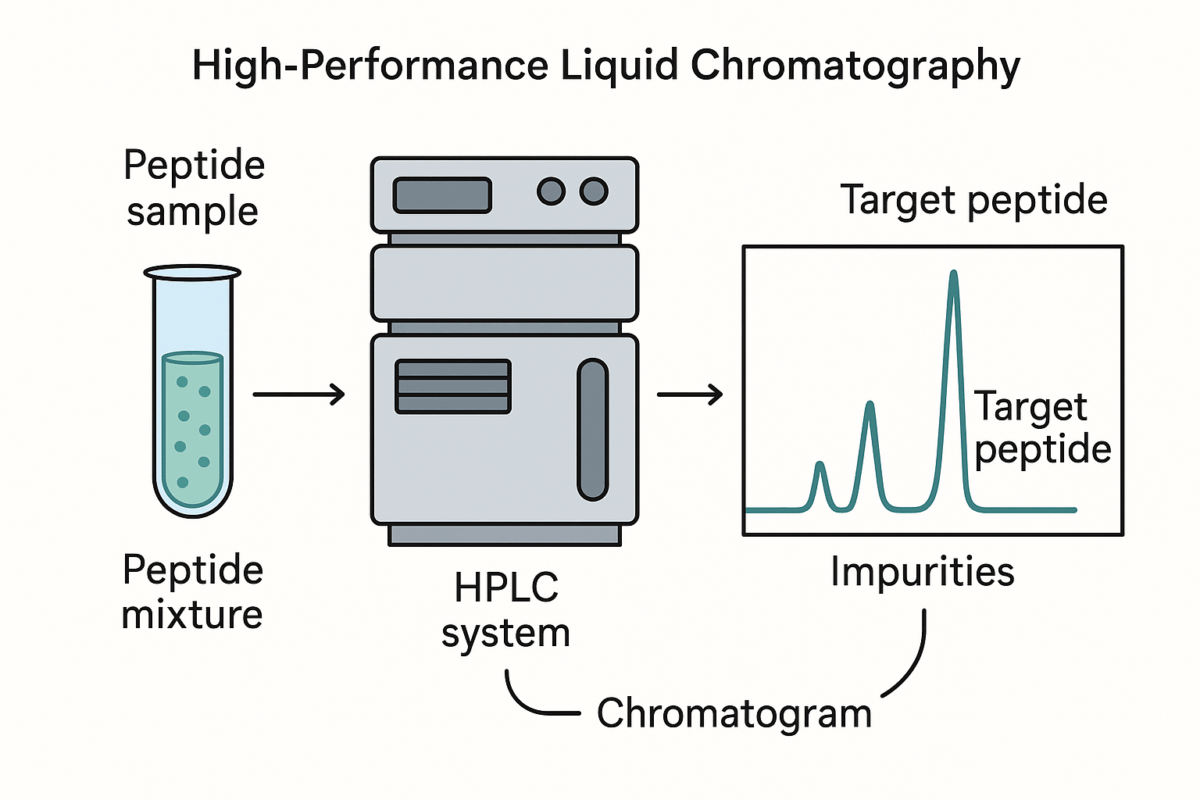
The buddy web page on why 99 percent purity issues explains why little impurity portions can still matter in delicate in-vitro assays. Together with this peptide testing guide, those pages develop the trust-methodology layer behind the product directory. Peptide testing is effective, yet researchers must read the range of each method thoroughly.Other techniques like electrophoresis, capillary electrophoresis (CE), and nuclear magnetic vibration (NMR) can additionally be made use of to analyze peptide structure, cost, and purity, making sure comprehensive characterization. In COA testimonial, it normally consists of HPLC purity screening, mass spectrometry identification verification, and batch-specific paperwork showing the checked great deal, approach, results, and date. For peptide purity screening, reverse-phase HPLC is the typical theoretical design. The chromatographic pureness is then calculated by comparing the area under the major top with the overall area under all incorporated peaks.
These can be specifically problematic since their chromatographic actions is extremely comparable to the target peptide, making them tougher to separate throughout filtration. When a peptide is 98% pure, that staying 2% isn't random sound-- it specifies, identifiable kinds of results. Mass spectrometry measures the molecular weight of a compound with extreme accuracy. For peptides, the most common techniques are electrospray ionization (ESI-MS) and matrix-assisted laser desorption/ionization time-of-flight (MALDI-TOF). HPLC divides a blend into its individual elements based on just how each particle interacts with a particularly made column.Ms/ms Fragmentation: Sequence Verification
- Peptides, with long molecular sequences and diverse conformations, existing challenges for structure verification and material resolution.
- Required for quantitative studies, structural biology, in vivo study models, and any kind of application where also percentages of impurity could affect results.
- This is important when the main inquiry is whether the observed component matches the desired peptide or whether an alteration has been incorporated as anticipated.
- Pureness is the percent of publications in the delivery that have every web page published appropriately, in the appropriate order, without missing chapters and no additional web pages stuffed in.
- HPLC can reveal the existence of added heights; LC-MS can help assign likely identifications to those related types.